

![[Translate to English:] La seconda tappa del Cammino dei Bronzi Dorati](/fileadmin/_processed_/d/6/csm_tappa3_ba1b4b2971.png)
![[Translate to English:] Montaiate - Pian dell'Abate](/fileadmin/cammino/mappe_dettagliate/05-Montaiate-PianDellAbate.png)
![[Translate to English:] Pian dell'Abate - Fenigli](/fileadmin/cammino/mappe_dettagliate/07-PianDellAbate-Fenigli.png)
![[Translate to English:] Fenigli - Monte Gherardo](/fileadmin/cammino/mappe_dettagliate/08-Fenigli-MonteGherardo.png)
![[Translate to English:] Monte Gherardo - Torricella](/fileadmin/cammino/mappe_dettagliate/09-MonteGherardo-Torricella.png)
![[Translate to English:] Torricella - Cartoceto](/fileadmin/cammino/mappe_dettagliate/10-Torricella-Cartoceto.png)
Third stage: from Montaiate to Cartoceto di Pergola
5:51 hours - 20.2 km - average speed 3.5 km/h - ascent 460 m - descent 830 m
- 28,45 Km - Montaiate (610m)
- 29,65 Km + detour 650m - Casa i prati dei daini
- 30,88 Km - Agriturismo la Vecchia Quercia
- 32,62 Km + detour 500m - Camping Confetti
- 34,60 Km Pian dell'Abate (460m)
- 35,51 Km + detour 500m - Colle del Lupo
- 37,18 Km Fenigli (620m)
- 40,55 Km + detour 300m - Azienda Agricola Monsanto
- 41,21 Km Monte Gherardo (500m)
- 42,49 Km + detour 800m - Casa San Biagio
- 46.26 Km Torricella di Fossombrone (320m)
- 48,69 Km Cartoceto (250m)
- 48.69 Km + detour 1800m - Agriturismo Calamello
- 48,69 Km + detour 1700m - Luogo di ritrovamento dei Bronzi Dorati
From Montaiate to Fenigli
From Montaiate, you descend toward the Cinisco River valley until you reach the main road connecting Pergola to Frontone. However, the asphalt section is very short—just a few hundred meters. Shortly after, on the right, take a gravel road that leads to Pian dell'Abate, a tiny hamlet. From here, leave the main road and turn left onto an uphill forest track.
For the first 50–100 meters, you need to pay close attention as the path might be hidden by tall grass; however, a little further on, the route enters the woods and becomes clearly visible.
Once out of the woods, you will cross another gravel road leading to Fenigli. Checking the map, you will see that the main trail turns left. Although you can reach Fenigli by going straight and slightly shortening the trip, we recommend following the main itinerary: it offers scenic views and leads into the village via a more picturesque route.
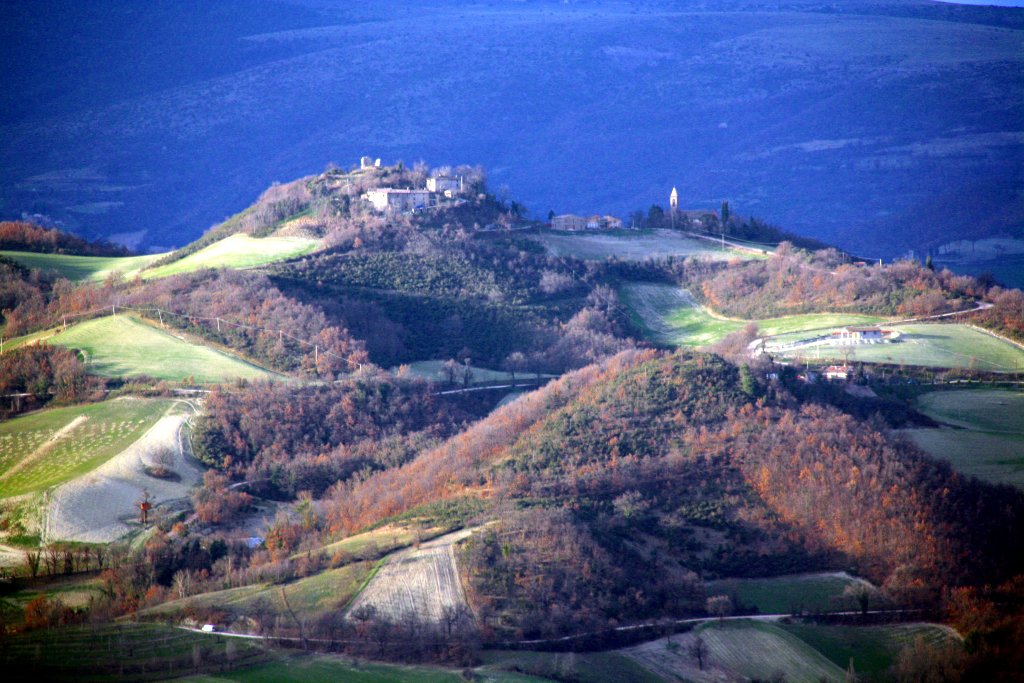
Upon arriving in Fenigli, it is well worth climbing to the top to see the ruins of the ancient castle, which offer a 360-degree panoramic view. The village is currently almost uninhabited and has been only partially restored, with some buildings still undergoing renovation.
In the area just below the village, you will find the former school, a characteristic stone house, and a complex that includes an ancient church. About 200 meters downhill lies the cemetery, where a small water fountain is available.
From Fenigli to Torricella
From Fenigli, the trail continues downhill, skirting a field to the right of the former school, which is easily recognizable by its typical post-war school architecture. The path then enters the woods until it intersects a gravel road after about half a kilometer; turn right here.
From this point until Monte Gherardo (in the Municipality of Cagli), the route develops almost entirely along a gravel road that runs along a ridge, offering magnificent panoramic views on both sides. Before reaching Monte Gherardo, about 300m off the trail to the left, you will find the Azienda Agricola Monsanto, where it is possible to stay overnight as well as taste and purchase local products. A small water fountain is located at the entrance to Monte Gherardo, and the village itself—built along a descending ridge—is well worth a visit down to its lower end.
Continuing on, you will follow a gravel road for about a kilometer, which gradually turns into a trail until it meets the road leading from Tarugo to Torricella and Cartoceto di Pergola.
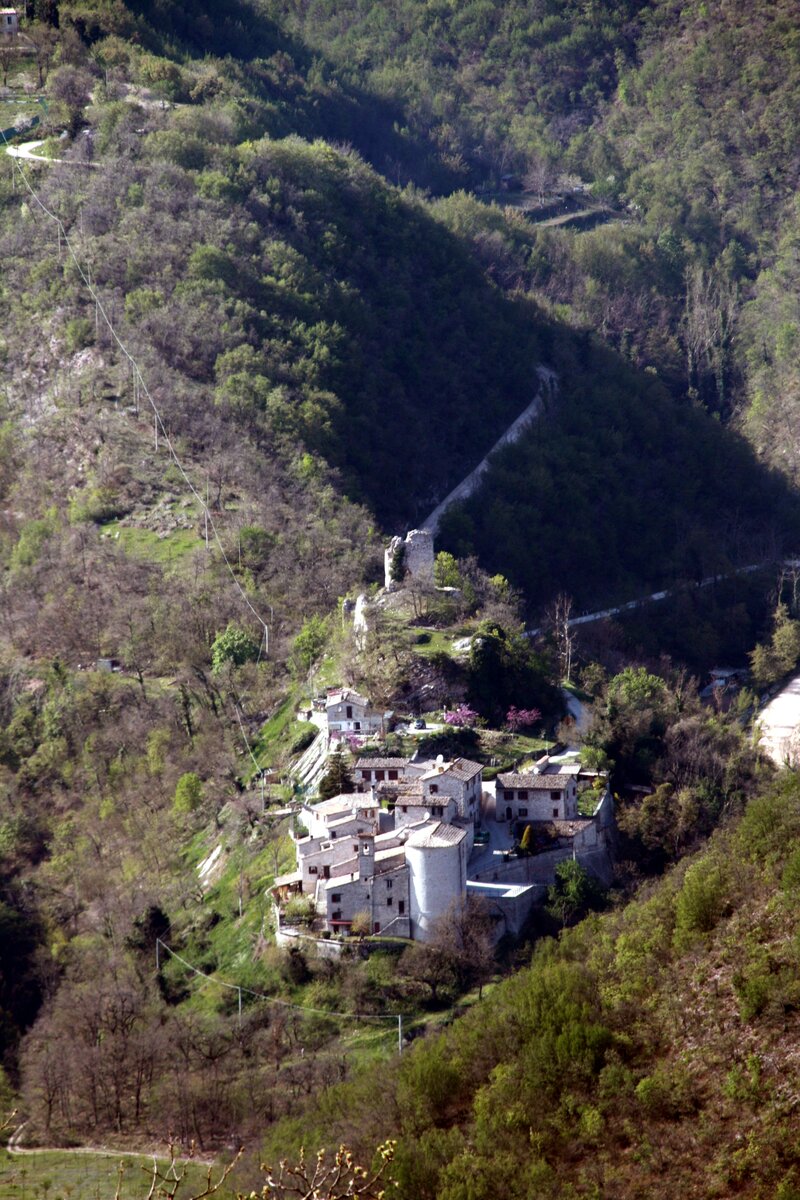
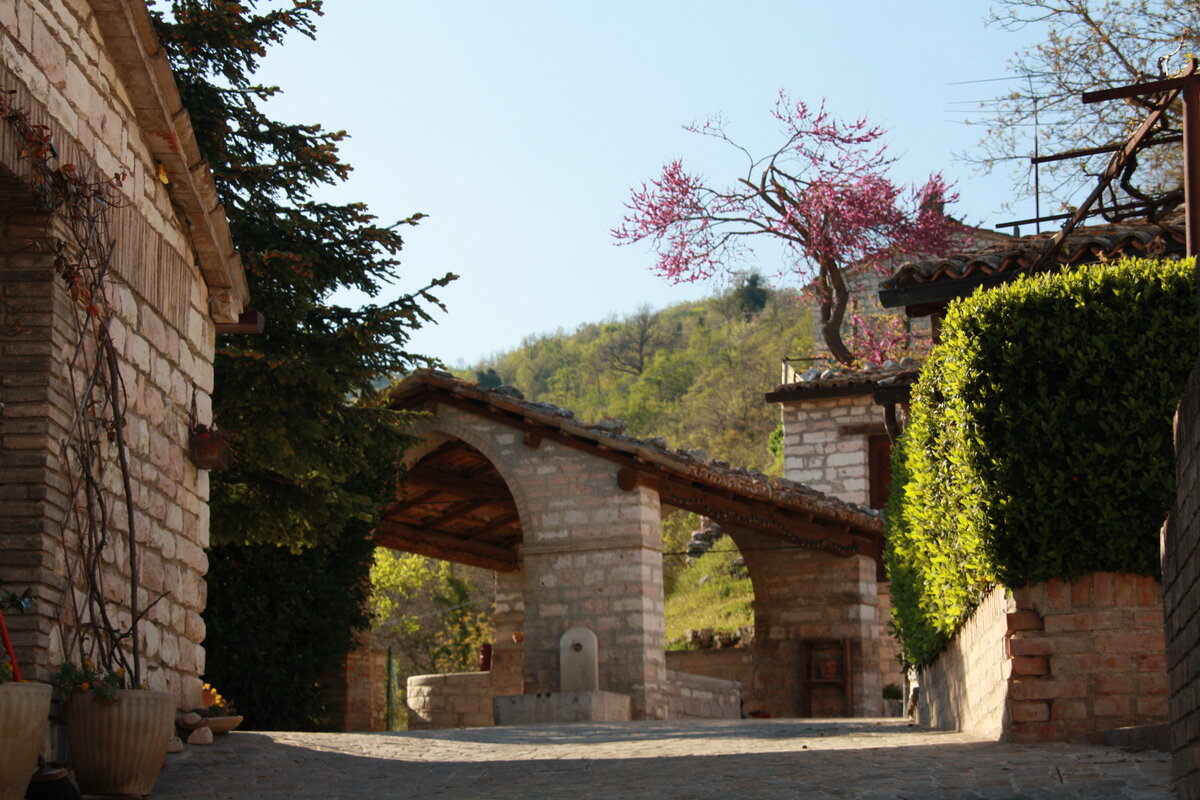
Torricella sits slightly above the main track and is absolutely worth a visit. In the heart of the village, the ancient wash-houses (lavatoi) house a water fountain. In addition to the steep narrow streets and the church, ruins of the castle are visible in the upper part of the village. In the lower section, you can walk along the path outside the walls, which offers an interesting historical perspective of the site.
To continue toward Cartoceto, you need to head back down to the main gravel road. The small village of Cartoceto does not have accommodation facilities, but nearby (1.8 km away) you can find Agriturismo Calamello, located along a slightly longer variant of the main route.
This alternative route passes near the site where the Gilded Bronzes were discovered in 1946, reconnecting with the main path after about 4 km.
The exact spot of the discovery is located in front of a house that is now in ruins; please note that there is currently no signage marking the event on-site. To delve deeper into the history of this extraordinary find, we recommend visiting the Museo dei Bronzi Dorati e della Città di Pergola (Museum of the Gilded Bronzes and the City of Pergola), where an engaging video in the immersive room recounts in detail the circumstances of the discovery and the events that followed.
Places along this stage
Fenigli.
Of Fenigli Castle, which has been documented since 1132 (predating the city of Pergola, founded in 1234), only a few ruins remain overlooking the tiny hamlet. Although very little of the original castle survives, the location is incredibly evocative and stands as one of the most beautiful viewpoints in the area. From the ruins of the ancient castle, your gaze can sweep across the Monte Catria massif and the Frontone Castle, reaching as far as the Adriatic coast by way of Pergola and the Cesano Valley.
Torricella.
Torricella is a hamlet in the Municipality of Fossombrone, located on the slopes of Monte Paganuccio on the side facing Pergola and the Tarugo valley. The first records of Torricella date back to 1224, when it was one of the eleven castles of the Fossombrone countryside. The town walls and the church are well-preserved, and the entire village has been perfectly restored in recent years. In the highest part of the hamlet, the ruins of the fortress tower still stand.